


Innovative musician and engineer Joseph Katzenberger redefines acoustic guitar design with Cimatron.
For decades, acoustic guitar players have been challenged with achieving greater volume and projection without sacrificing tonal quality.
While electric guitars have evolved rapidly through amplification technology, the traditional acoustic guitar has remained largely unchanged. Though valued for its natural sound, the acoustic has long been overpowered by other, more powerful instruments because of its inherent design.
For Joseph Katzenberger — an engineer, product development specialist, and inventor — that challenge became the inspiration for a new approach to acoustic guitar design.
“It all started with a simple question,” said Katzenberger, owner of Katzenberger Engineering and Innovations, or KEI. “How can I give the acoustic guitar more power without sacrificing its beautiful tone?”
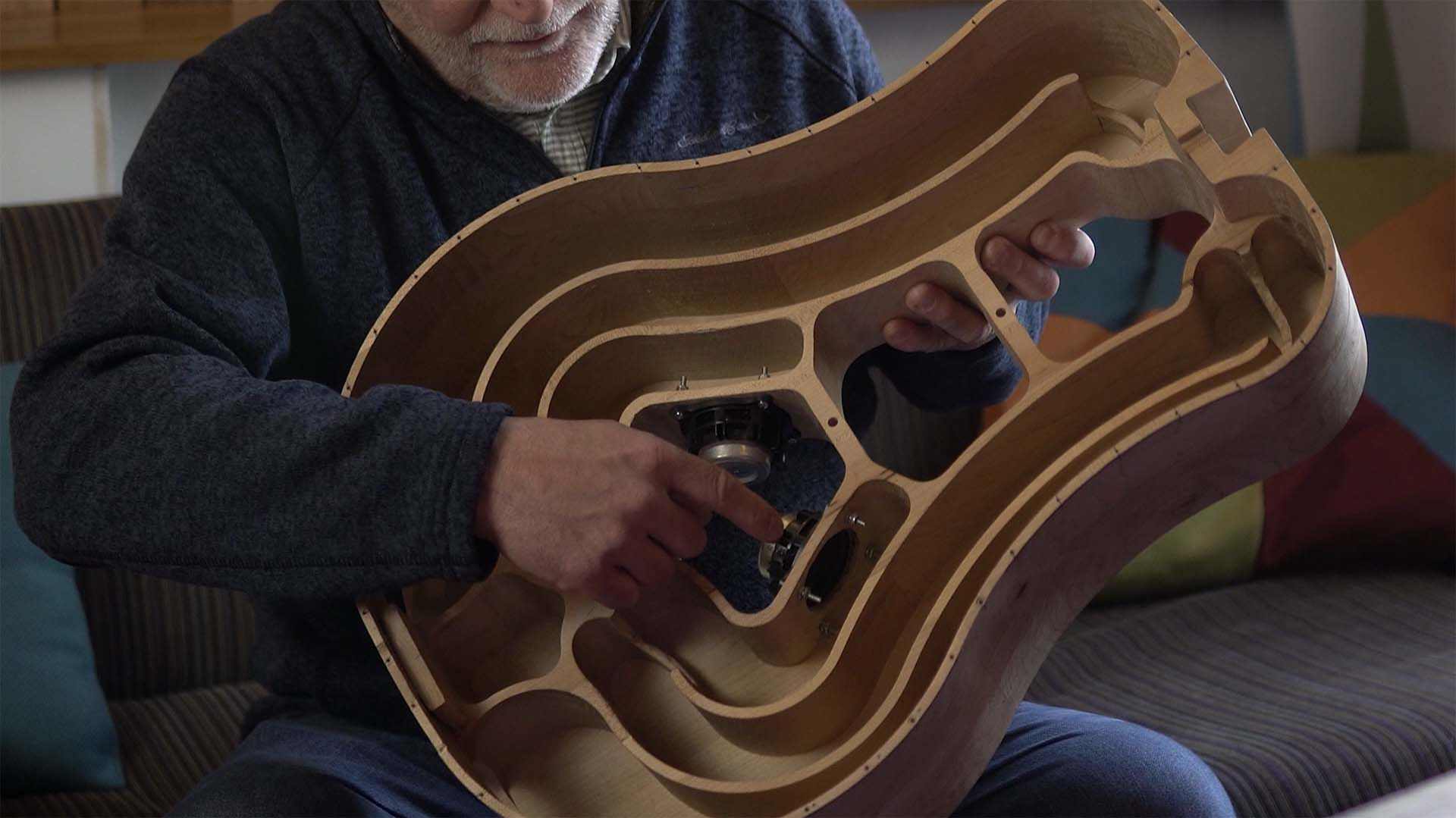
That question ultimately led to the invention of Katzenberger’s patented Folded Horn Acoustic Guitar, an instrument that reflects acoustic waveguide and folded horn technology — commonly found in high-end speaker systems — applied to guitar design.
Where music and engineering meet
An engineer by profession and lifelong amateur musician by passion, Katzenberger spent years thinking about how technology could improve the acoustic guitar experience.
“Engineering was my full-time job, but I always wanted to combine music and engineering somehow and improve the guitar,” said Katzenberger, a senior project engineer at Regal Mold of Elkhart, Indiana.
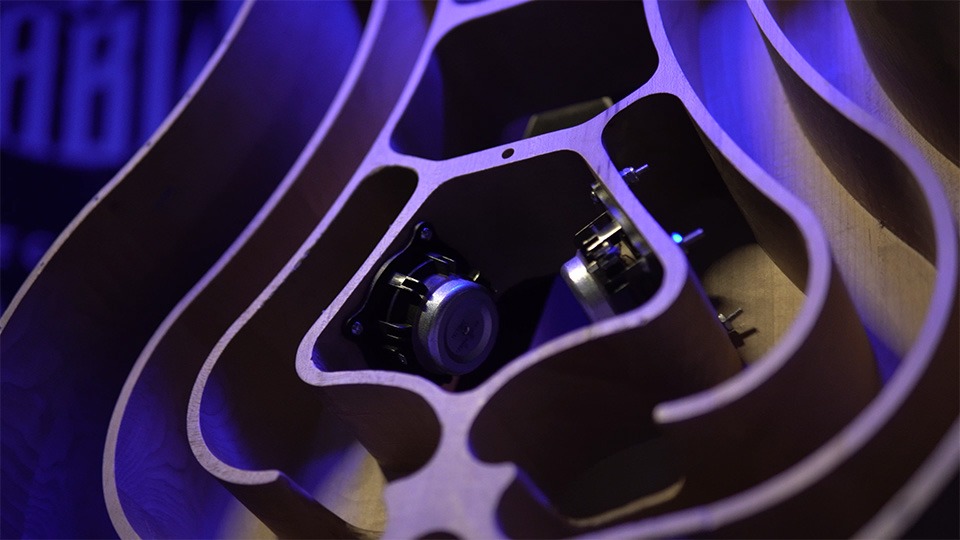
The concept for the guitar stemmed from a realization that speaker manufacturers had long used folded horns and acoustic waveguides to efficiently project sound and enhance bass response, yet similar principles had never been truly applied to acoustic guitars.
“Acoustic guitars have been underpowered from the day they were invented,” Katzenberger said. “The goal was to make it louder while keeping the classic tone.”
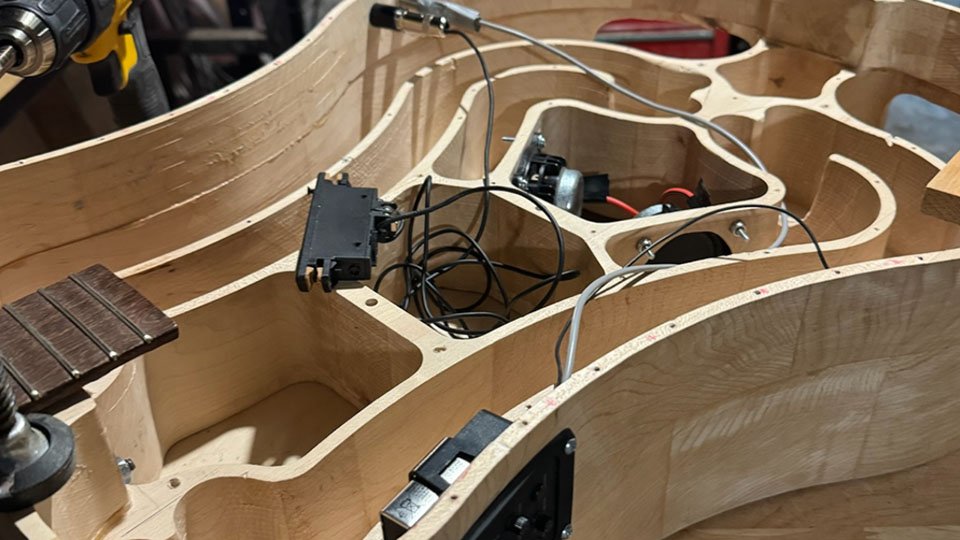
His resulting design integrates internal folded horns, which are approximately five feet long when unfolded, directly in the guitar body. The internal pathways help project sound more efficiently with full range speakers, while enriching tonal warmth and bass response.
FROM VISION TO REALITY
How integrated CAD/CAM helped turn an unconventional acoustic-guitar concept into a CNC-machined prototype
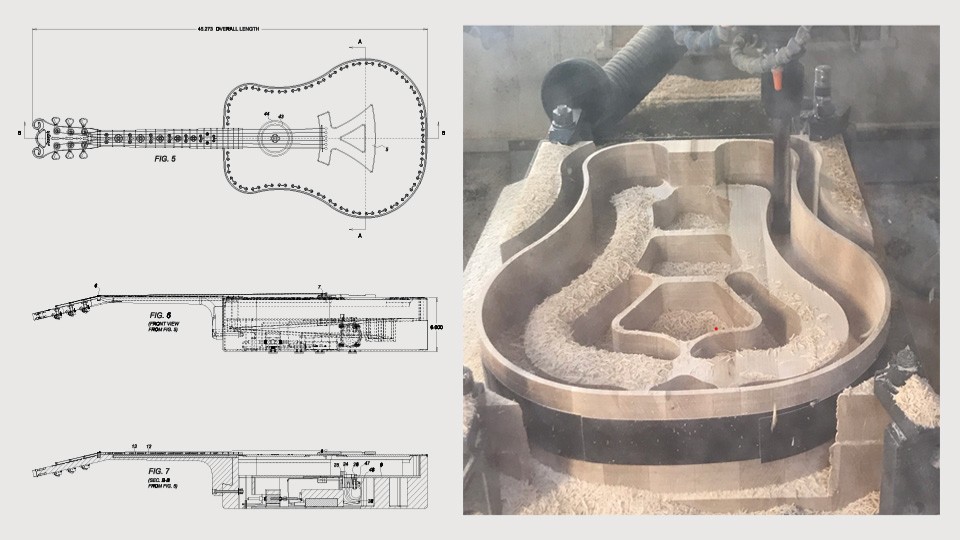
Transforming the concept of the Folded Horn Acoustic Guitar into a manufacturable product required advanced CAD/CAM technology and extensive design iteration. Katzenberger used Cimatron at Regal Mold to design and manufacture the guitar prototypes, using the company’s integrated CAD/CAM software and CNC machining capabilities.
“The first thing I did was design it in Cimatron,” Katzenberger said. “I probably redesigned it ten times.” The software’s integrated workflow proved especially valuable during prototype development.
“I could take the design directly from CAD into programming and then directly to the CNC machine using the same Cimatron files,” Katzenberger said. “That’s a big deal.”
The guitar body itself presented unique manufacturing challenges. Each prototype was machined from a solid block of hard maple approximately six inches thick, 18 inches wide, and 24 inches long.
“I didn’t know if it was going to come off the CNC machine in one piece because it had never been done before,” he said. The internal folded horn geometry entailed tall, thin wall structures that required careful machining strategies to maintain structural integrity throughout the cutting process. As it was machined from wood rather than typical metals, machining parameters also had to be carefully adjusted.
“The speeds and feeds were critical,” Katzenberger said. “You can’t use coolant on wood, and you have to make sure the chips evacuate properly.” Despite the complexity, the prototype machining process was successful. “It worked beautifully,” he said.
Manufacturing traditional craftsmanship
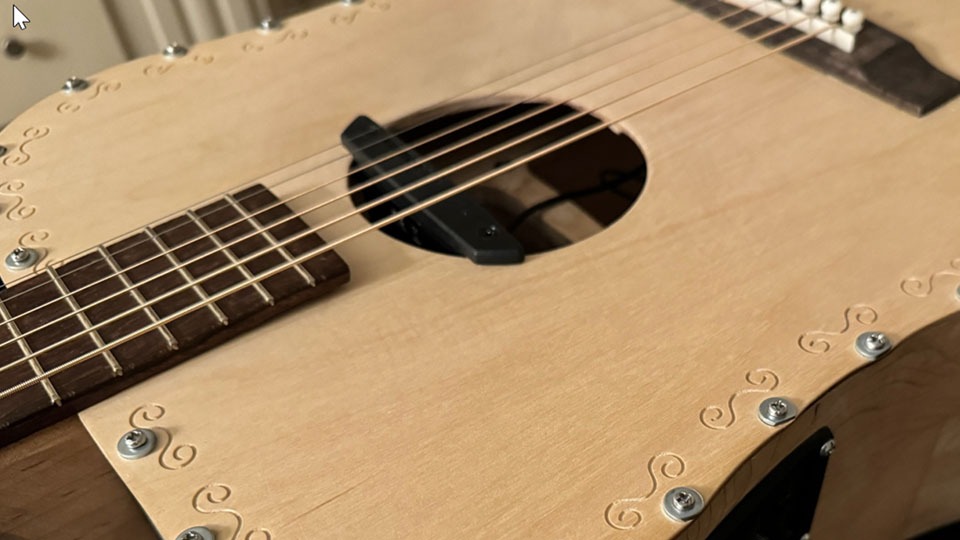
While CAD/CAM technology made the design manufacturable, traditional instrument craftsmanship remained equally important. Katzenberger selected hard maple for the guitar body because of its strength and stability, while spruce was chosen for the soundboard due to its long-standing reputation in high-end string instruments.
“Spruce is considered one of the best soundboard woods in the world for string instruments,” he explained. “Violins, cellos, guitars — many use spruce tops because the grain structure carries sound extremely well.” The result is an instrument that combines engineering precision with traditional acoustic character.

Wood is beautiful, makes the instrument sound amazing, and has soul. I want to retain and improve the best parts of traditional instruments, not throw them away.”
Redefining the “impossible”
Today, Katzenberger continues refining his concept while pursuing opportunities to bring the technology to larger-scale production.
The folded horn acoustic guitar has already generated significant interest among musicians, audio enthusiasts, and manufacturers intrigued by its unconventional design and powerful sound.
“People have never seen anything like it before, and the response has been overwhelmingly positive,” Katzenberger said. For Katzenberger, the invention reflects a broader philosophy of combining engineering creativity with practical problem-solving.
“As an engineer and innovator, my drive is to find design solutions for complex problems,” he said. “These patents embody that commitment to continuous improvement.”
By combining CAD/CAM technology and acoustic engineering principles, Katzenberger has demonstrated how digital manufacturing tools can help transform ambitious ideas into working reality.
The two patents that cover this product are U.S. Patent #10,777,172 and U.S. Patent #12,094,438. Both are (20) year utility patents.
More information and YouTube video are available at katzenberger-engineering.com